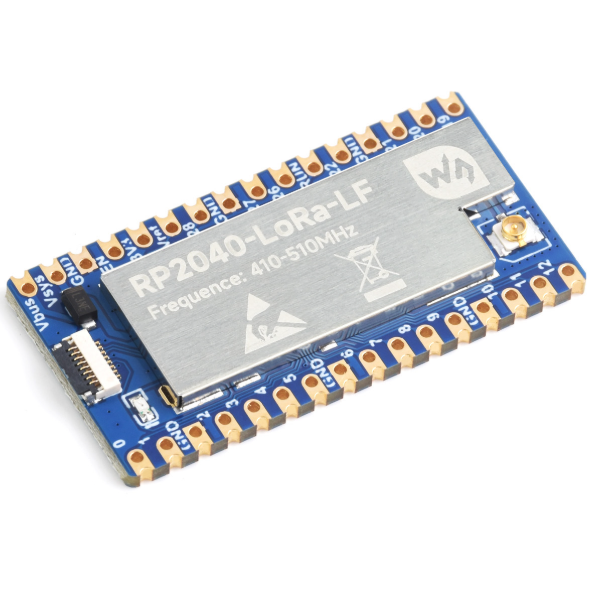
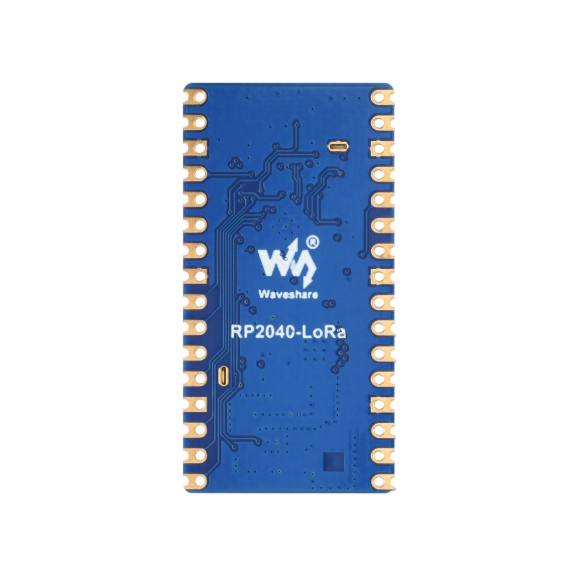
Il s'agit d'une carte de développement intégrée combinant le microcontrôleur Raspberry Pi RP2040 et la puce RF Semtech SX1262 LoRa..
Il est conçu pour:
- Faible consommation d'énergie
- Communication longue portée
- Développement facile
- Intégration évolutive de la production de masse
Prise en charge:
- Communication point à point LoRa
- Réseaux de diffusion et de relais
- Développement de terminaux LoRaWAN (avec prise en charge de la passerelle)
1. Positionnement de base & Avantages clés
Microcontrôleur (MCU)
- Framboise Pi RP2040 (puce officielle)
- Cortex-M0+ double cœur 133 MHz
- 264 Ko de SRAM + 2 Mo Flash
- Prend en charge MicroPython, C/C++, et programmation par glisser-déposer d'UF2
- Écosystème mature, adapté aux débutants
Performances RF (SX1262)
- Puce LoRa de nouvelle génération (mise à niveau à partir du SX1278)
- Sensibilité du récepteur: -148 dBm
- Puissance de transmission maximale: 22 dBm
- Consommation ultra faible: dormir < 2 µA
- Forte performance anti-interférence
- Portée de communication: 5–8km+ (ligne de mire)
Conception matérielle
- Trou de tampon + embase à broches double conception
- Convient pour une intégration directe sur PCB (production de masse)
- Prend également en charge le prototypage de la maquette
- Interface de type C détachable (via connecteur FPC)
- Permet le débogage et la programmation
- Peut être retiré en production pour réduire les coûts
Protocoles de communication
- Prise en charge native de:
- LoRa point à point
- Diffuser
- Réseau de relais
- Prise en charge LoRaWAN (Classe A/B) via l'intégration de la passerelle
- Compatible avec TTN et ChirpStack
- Idéal pour les déploiements LPWAN IoT
2. Spécifications clés (LF / Versions HF)
| Paramètre | Spécification |
|---|---|
| MCU | RP2040 (Cortex-M0+ double cœur à 133 MHz, 264 Ko de SRAM, 2 Mo Flash) |
| Puce RF | Semtech SX1262 |
| Fréquence | LF: 410–525 MHz (433/470 MHz) / HF: 850–930 MHz (868/915 MHz) |
| Modulation | LoRa / (G)FSK |
| Puissance de transmission | 0–22 dBm (10 / 13 / 17 / 22 dBm réglable) |
| Sensibilité du récepteur | -148 dBm @ 2.4 kbps (SF12, 125 kHz) |
| Débit de données | LoRa: 0.3–62,5 kbit/s; FSK: jusqu'à 300 kbps |
| Gamme | 5–8km+ (LDV, 22 dBm + 5 Antenne dBi) |
| Consommation d'énergie | Émission: 107–118 mA; RX: 5.3 mA; Dormir: <2 µA |
| Alimentation | 3.3V (Type-C ou en-tête à broches), batterie prise en charge |
| Interfaces | IPS, GPIO, UART, I2C, MLI, CDA |
| Antenne | Connecteur IPEX (prend en charge SMA / antenne externe) |
| Taille | 21 × 41 mm (Facteur de forme pico-compatible) |
| Température de fonctionnement | -40°C à +85°C |
3. Matériel embarqué & Interfaces
Section MCU RP2040
- Cortex-M0+ double cœur jusqu'à 133 MHz
- Intégré 264 Ko SRAM et 2 Mo Flash
- Prend en charge la programmation glisser-déposer UF2 (Mode de stockage de masse USB)
Extension GPIO:
- 20+ GPIO multifonctions
- Prend en charge SPI, I2C, UART, MLI, CDA
- Compatible avec l'écosystème Raspberry Pi Pico
Boutons & Indicateurs:
- Bouton de réinitialisation
- Bouton DÉMARRAGE (entrer en mode programmation)
- LED d'alimentation et d'état
Conception modulaire:
- La carte mère se connecte via FPC (8-épingle) vers adaptateur Type-C
- L'adaptateur fournit de l'énergie, débogage, et programmation
- Peut être retiré pour une intégration directe sur PCB
Section RF SX1262
- Circuit RF indépendant avec blindage pour une stabilité améliorée
- Connecteur d'antenne IPEX pour antennes externes à gain élevé
- Communication SPI avec RP2040
Prend en charge les fonctionnalités avancées:
- Réveil à la radio (WOR)
- Écoutez avant de parler (LBT)
- Vérification des erreurs CRC
- Détection RSSI
- Filtrage d'adresses
- Cryptage des données
4. Fonctions principales & Fonctionnalités de développement
Communication LoRa
- Point à point / Diffuser / Multidiffusion
Communication directe entre les nœuds sans passerelle - Relais multi-sauts
Étend la portée de communication et surmonte les obstacles - Prise en charge des terminaux LoRaWAN
Compatible avec TTN et ChirpStack pour la connectivité cloud
Fonctionnement à très faible consommation
- Prend en charge WOR (Réveil à la radio)
- Les nœuds restent en mode veille et se réveillent périodiquement
- Fonctionnement sur batterie pour mois à 1 année
Écosystème de développement
- Langages de programmation:
- MicroPython (recommandé pour le prototypage rapide)
- C/C++ (Arduino / SDK Pico)
- Débogage:
- Interface de type C pour la communication série
- Outils PC pour la configuration et la transmission de données
- Ressources:
- Wiki officiel
- Schémas & Fichiers PCB
- Exemple de code (Python / C)
- Exemples d'intégration LoRaWAN
- Jeu de commandes AT
5. Applications typiques
Appareils terminaux IoT
- Température, humidité, pression, niveau de liquide, sol, Capteurs PM2,5
- Compteurs intelligents (électricité, eau, gaz)
- Systèmes de sécurité (alarmes, détection de mouvement)
Systèmes sans fil industriels
- Communication automate
- Surveillance des équipements
- Systèmes de contrôle à distance
- Réseau IoT d'usine
Agriculture intelligente & Surveillance environnementale
- Serres
- Stations météo
- Surveillance de la qualité de l'eau
- Détection des incendies de forêt
- Détection extérieure à distance
Appareils alimentés par batterie
- Longue portée, transmission sans fil de faible puissance
- Idéal pour les environnements éloignés et hors réseau
Intégration de la production de masse
- La conception à trou embouti permet un soudage direct sur les circuits imprimés du produit
- Élimine le besoin d'un MCU séparé + Module LoRa
- Réduit le coût et la complexité du système
6. Développement & Notes d'utilisation
Configuration du matériel
- Connectez-vous via une planche à pain ou soudez sur une plinthe
- Fixez l'antenne IPEX (ne pas transmettre sans antenne)
- Alimentation via Type-C ou 3,3 V
Démarrage rapide
- Utiliser MicroPython avec le pilote SX1262
- Configurer la fréquence, débit de données, et transmettre la puissance
- Utiliser les fonctions d'envoi/réception pour la communication
Conformité de fréquence
- Utiliser la version LF (433/470 MHz) pour la Chine
- Suivez les réglementations RF locales en matière de puissance et de fréquence
Remarques importantes
- SX1262 est une puce de couche physique
- LoRaWAN nécessite la mise en œuvre d'une pile de protocoles ou de bibliothèques
- La communication point à point ne nécessite PAS de passerelle
- LoRaWAN nécessite une passerelle compatible