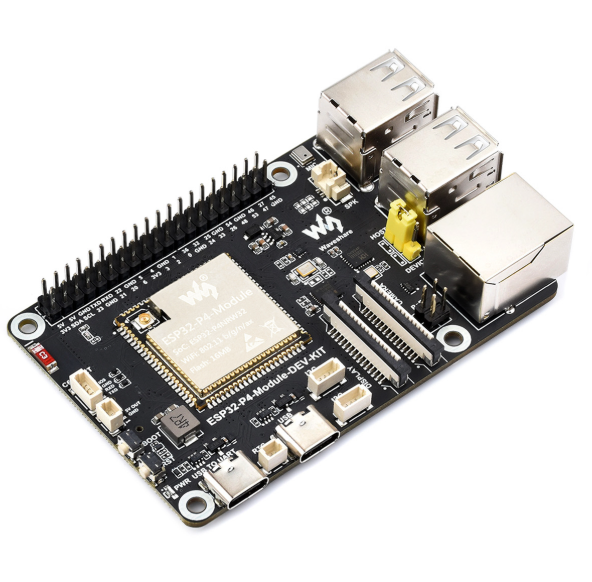
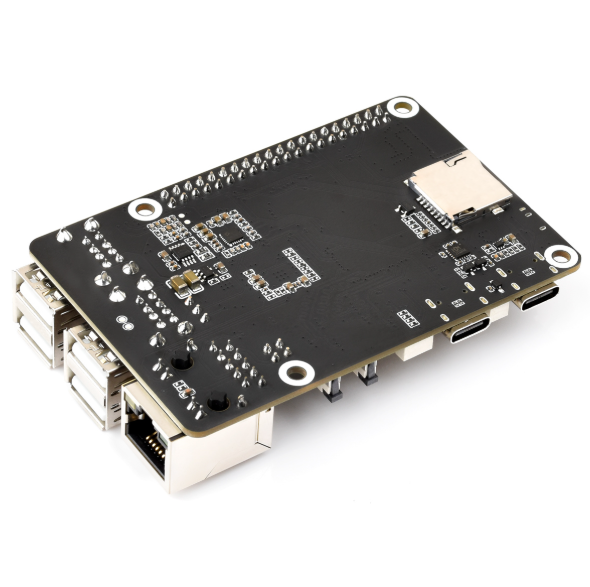
The ESP32-P4-Module is a high-performance dual-core RISC-V development board based on the ESP32-P4 chip.
It provides rich human–machine interface (HMI) capabilities, including MIPI-CSI (with integrated Image Signal Processor, ISP) and MIPI-DSI display interfaces. In addition, it supports a wide range of commonly used peripherals such as SPI, I2S, I2C, LED PWM, MCPWM, RMT, ADC, UART, and TWAI™.
For high-speed connectivity, the board supports USB OTG 2.0 HS, Ethernet, and SDIO Host 3.0. The chip also integrates a digital signature peripheral and a dedicated key management unit, ensuring strong system security.
The ESP32-P4-Module-DEV-KIT is designed for high-performance and high-security applications, fully meeting the advanced requirements of embedded systems in areas such as human-machine interface support, edge computing capability, and rich I/O connectivity.
1. Core Positioning & Board Differences
Module Definition
“Module” refers to a modular full-featured development board, built on a pre-packaged ESP32-P4 core module rather than a bare chip design.
Compared to ESP32-P4-NANO:
- Larger size
- More GPIOs and interfaces
- Stronger expansion capability
- Closer to the functionality of official Espressif evaluation boards
Dual-Chip Architecture
- Main chip: ESP32-P4 (high-performance dual-core RISC-V)
- Co-processor: ESP32-C6-MINI (Wi-Fi 6 + BLE via SDIO 3.0 high-speed interface)
Note: The ESP32-P4 itself does not include native wireless capability. All wireless functions are handled by the C6 module.
Dimensions
- Approx. 85 × 56 mm (standard development board size)
- Onboard 40-pin GPIO header (partially compatible with Raspberry Pi HATs)
- Easy connection to sensors, displays, and external modules

2. Core Hardware Specifications (ESP32-P4)
2.1 Processor & Performance
- HP Core (High Performance):
- 32-bit dual-core RISC-V
- Up to 360 MHz (max 400 MHz)
- Integrated DSP, FPU, and AI instruction extensions
- Supports edge AI inference, video encoding/decoding, and HMI rendering
- LP Core (Low Power):
- 32-bit single-core RISC-V
- 40 MHz
- Handles low-power standby, sensor polling, and background tasks
- μA-level standby power consumption
- Wireless Co-processor:
- ESP32-C6-MINI
- Supports Wi-Fi 6 (802.11ax), Bluetooth 5.3 / BLE
- 2.4 GHz band
- High-speed SDIO 3.0 interface
2.2 Memory Configuration
- On-chip:
- 128 KB HP ROM
- 16 KB LP ROM
- 768 KB HP L2 SRAM
- 32 KB LP SRAM
- 8 KB TCM (zero-wait access)
- Stacked Memory:
- 32 MB PSRAM (for 1080P video, AI models, large GUI)
- External:
- 16 MB QSPI NOR Flash (program/data storage)
2.3 Key Peripherals & Interfaces
Multimedia / HMI (Highlight Features)
- MIPI-DSI Display:
- 2-lane, up to 1080P @ 30fps
- Built-in 2D DMA, JPEG decoder, PPA pixel accelerator
- Direct connection to LCD / touchscreen
- MIPI-CSI Camera:
- 2-lane with integrated ISP
- Supports 1080P @ 30fps
- H.264 / JPEG encoding
- Suitable for vision capture, surveillance, AI recognition
- Audio:
- Onboard MEMS microphone
- Speaker amplifier interface
- I2S / PCM support
- Supports recording, playback, voice wake-up, offline speech recognition
High-Speed Communication & Storage
- Ethernet:
- 100 Mbps RJ45
- Optional PoE support (power + data over single cable)
- USB:
- Type-C (power, flashing, debugging)
- Type-A USB 2.0 OTG HS (U-disk, keyboard/mouse, camera, 4G module)
- SDIO 3.0:
- TF card slot
- Supports high-speed storage expansion (128GB+)
General IO & Expansion
- 40-pin Header:
- 28+ programmable GPIOs
- Supports SPI, I2S, I2C, UART, ADC, PWM, MCPWM, RMT, TWAI (CAN), I3C
- Onboard Components:
- BOOT / RESET buttons
- User LED
- RTC battery holder
- Power indicator
- PoE expansion interface
- Debug interface
2.4 Power & Consumption
- Power Input:
- Type-C 5V
- Optional PoE
- 5V / 3.3V header input
- Power Consumption:
- High-performance mode: ~1.5–2.5W
- Low-power mode (LP core): <10μA
2.5 Security Features
- Secure Boot
- Flash Encryption
- Hardware cryptographic accelerators (AES-256, SHA-256, RSA)
- Key management unit
- Digital signature peripheral
Ensures firmware, data, and communication security.
3. Development Environment & Software Support
- Compatible with ESP-IDF v5.2+ (official framework, C/C++, FreeRTOS, ESP-RainMaker cloud)
- Supports Arduino ecosystem for rapid prototyping
- Official resources include:
- Schematics
- PCB design files
- Drivers
- Example code (camera, display, networking, audio, AI)
- Wiki documentation and technical support
4. Typical Applications
- High-performance HMI / smart control panels
- Edge AI / vision recognition (face/object detection, 1080P surveillance)
- High-speed IoT gateways (Wi-Fi 6 + Ethernet + PoE)
- Multimedia & voice interaction devices (smart speakers, video terminals, dashcams)
- Industrial automation, robotics, drones, handheld smart devices
5. Key Advantages (vs ESP32-P4-NANO)
- Full-featured design: No interface reduction (MIPI, Ethernet, USB, 40-pin expansion)
- Modular architecture: Better stability and EMI performance
- Strong expandability: Raspberry Pi HAT-compatible header
- Industrial readiness: Supports PoE, Ethernet, wide voltage input, and security features