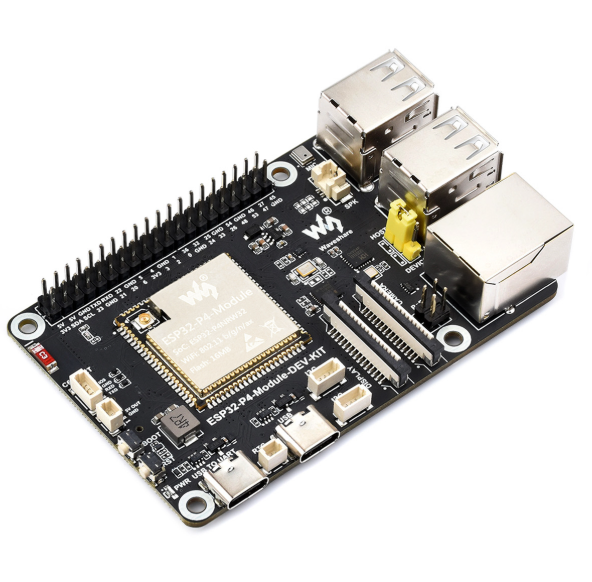
Der ESP32-P4-Modul ist ein leistungsstarkes Dual-Core-RISC-V-Entwicklungsboard basierend auf dem ESP32-P4-Chip.
Es bietet eine umfassende Mensch-Maschine-Schnittstelle (HMI) Fähigkeiten, einschließlich MIPI-CSI (mit integriertem Bildsignalprozessor, ISP) Und MIPI-DSI Anzeigeschnittstellen. Zusätzlich, Es unterstützt eine Vielzahl häufig verwendeter Peripheriegeräte wie SPI, I2S, I2C, LED-PWM, MCPWM, RMT, ADC, UART, und TWAI™.
Für Hochgeschwindigkeitsverbindungen, Das Board unterstützt USB-OTG 2.0 HS, Ethernet, Und SDIO-Host 3.0. Der Chip integriert auch a Peripheriegerät für digitale Signatur und eine engagierte Schlüsselverwaltungseinheit, Gewährleistung einer starken Systemsicherheit.
Das ESP32-P4-Module-DEV-KIT ist für Hochleistungs- und Hochsicherheitsanwendungen konzipiert, Es erfüllt die erweiterten Anforderungen eingebetteter Systeme in Bereichen wie der Unterstützung von Mensch-Maschine-Schnittstellen vollständig, Edge-Computing-Fähigkeit, und umfangreiche I/O-Konnektivität.
1. Kernpositionierung & Board-Unterschiede
Moduldefinition
„Modul“ bezieht sich auf a Modulares Entwicklungsboard mit vollem Funktionsumfang, Es basiert auf einem vorgefertigten ESP32-P4-Kernmodul und nicht auf einem Bare-Chip-Design.
Im Vergleich zu ESP32-P4-NANO:
- Größere Größe
- Mehr GPIOs und Schnittstellen
- Stärkere Erweiterungsfähigkeit
- Näher an der Funktionalität offizieller Espressif-Evaluierungsboards
Dual-Chip-Architektur
- Hauptchip: ESP32-P4 (Hochleistungs-Dual-Core-RISC-V)
- Co-Prozessor: ESP32-C6-MINI (W-lan 6 + BLE über SDIO 3.0 Hochgeschwindigkeitsschnittstelle)
Notiz: Der ESP32-P4 selbst verfügt nicht über native WLAN-Funktionen. Alle Funkfunktionen werden vom C6-Modul übernommen.
Abmessungen
- Ca. 85 × 56 mm (Standard-Entwicklungsplatinengröße)
- An Bord 40-Pin GPIO-Header (teilweise kompatibel mit Raspberry Pi HATs)
- Einfache Anbindung an Sensoren, zeigt an, und externe Module

2. Kern-Hardware-Spezifikationen (ESP32-P4)
2.1 Prozessor & Leistung
- HP Core (Hohe Leistung):
- 32-Bit Dual-Core RISC-V
- Bis zu 360 MHz (max 400 MHz)
- Integrierter DSP, FPU, und KI-Anweisungserweiterungen
- Unterstützt Edge-KI-Inferenz, Videokodierung/-dekodierung, und HMI-Rendering
- LP-Kern (Geringe Leistung):
- 32-Bit-Single-Core-RISC-V
- 40 MHz
- Bewältigt den Standby-Modus mit geringem Stromverbrauch, Sensorabfrage, und Hintergrundaufgaben
- Standby-Stromverbrauch auf μA-Ebene
- Drahtloser Co-Prozessor:
- ESP32-C6-MINI
- Unterstützt WLAN 6 (802.11Axt), Bluetooth 5.3 / BLE
- 2.4 GHz-Band
- Hochgeschwindigkeits-SDIO 3.0 Schnittstelle
2.2 Speicherkonfiguration
- Auf dem Chip:
- 128 KB HP ROM
- 16 KB-LP-ROM
- 768 KB HP L2 SRAM
- 32 KB LP SRAM
- 8 KB TCM (Zugriff ohne Wartezeit)
- Gestapelter Speicher:
- 32 MB PSRAM (für 1080P-Video, KI-Modelle, große GUI)
- Extern:
- 16 MB QSPI NOR Flash (Programm-/Datenspeicherung)
2.3 Wichtige Peripheriegeräte & Schnittstellen
Multimedia / HMI (Markieren Sie Funktionen)
- MIPI-DSI-Anzeige:
- 2-Fahrbahn, Bis zu 1080P bei 30 Bildern pro Sekunde
- Integriertes 2D-DMA, JPEG-Decoder, PPA-Pixelbeschleuniger
- Direkter Anschluss an LCD / Touch-Screen
- MIPI-CSI-Kamera:
- 2-Spur mit integriertem ISP
- Unterstützt 1080P bei 30 Bildern pro Sekunde
- H.264 / JPEG-Kodierung
- Geeignet für die Bilderfassung, Überwachung, KI-Erkennung
- Audio:
- Integriertes MEMS-Mikrofon
- Schnittstelle für Lautsprecherverstärker
- I2S / PCM-Unterstützung
- Unterstützt die Aufnahme, Wiedergabe, Sprachwecken, Offline-Spracherkennung
Hochgeschwindigkeitskommunikation & Lagerung
- Ethernet:
- 100 Mbit/s RJ45
- Optionale PoE-Unterstützung (Leistung + Daten über ein einziges Kabel)
- USB:
- Typ-C (Leistung, blinkt, Debuggen)
- Typ-A-USB 2.0 OTG HS (U-Disk, Tastatur/Maus, Kamera, 4G-Modul)
- SDIO 3.0:
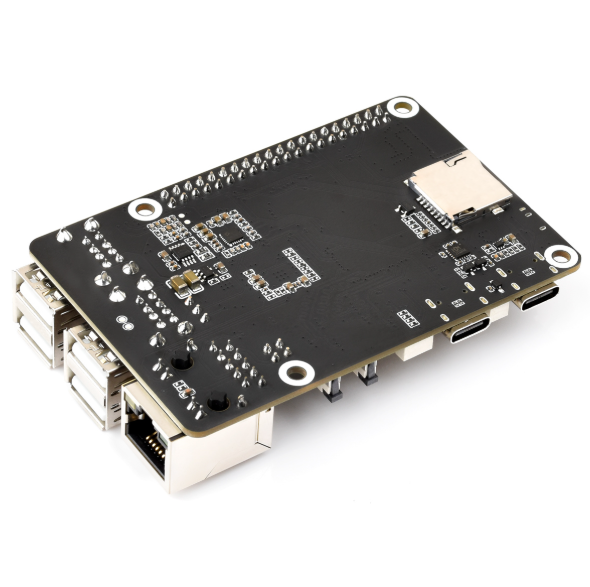
- TF-Kartensteckplatz
- Unterstützt Hochgeschwindigkeits-Speichererweiterung (128GB+)
Allgemeines IO & Erweiterung
- 40-Pin-Header:
- 28+ programmierbare GPIOs
- Unterstützt SPI, I2S, I2C, UART, ADC, PWM, MCPWM, RMT, ZWEIMAL (DÜRFEN), I3C
- Onboard-Komponenten:
- STIEFEL / RESET-Tasten
- Benutzer-LED
- RTC-Batteriehalter
- Betriebsanzeige
- PoE-Erweiterungsschnittstelle
- Debug-Schnittstelle
2.4 Leistung & Verbrauch
- Leistungsaufnahme:
- Typ-C 5V
- Optionales PoE
- 5V / 3.3V-Header-Eingabe
- Stromverbrauch:
- Hochleistungsmodus: ~1,5–2,5 W
- Energiesparmodus (LP-Kern): <10μA
2.5 Sicherheitsfunktionen
- Sicherer Start
- Flash-Verschlüsselung
- Hardware-Kryptografiebeschleuniger (AES-256, SHA-256, RSA)
- Schlüsselverwaltungseinheit
- Peripheriegerät für digitale Signatur
Stellt Firmware sicher, Daten, und Kommunikationssicherheit.
3. Entwicklungsumgebung & Softwareunterstützung
- Kompatibel mit ESP-IDF v5.2+ (offizieller Rahmen, C/C++, FreeRTOS, ESP-RainMaker-Cloud)
- Unterstützt Arduino-Ökosystem für schnelles Prototyping
- Zu den offiziellen Ressourcen gehören::
- Schaltpläne
- PCB-Designdateien
- Treiber
- Beispielcode (Kamera, Anzeige, Vernetzung, Audio-, KI)
- Wiki-Dokumentation und technischer Support
4. Typische Anwendungen
- Hochleistungs-HMI / Intelligente Bedienfelder
- Edge-KI / Seherkennung (Gesichts-/Objekterkennung, 1080P-Überwachung)
- Hochgeschwindigkeits-IoT-Gateways (W-lan 6 + Ethernet + PoE)
- Multimedia & Sprachinteraktionsgeräte (Intelligente Lautsprecher, Videoterminals, Dashcams)
- Industrielle Automatisierung, Robotik, Drohnen, Handheld-Smart-Geräte
5. Hauptvorteile (vs. ESP32-P4-NANO)
- Voll ausgestattetes Design: Keine Schnittstellenreduzierung (MIPI, Ethernet, USB, 40-Pin-Erweiterung)
- Modulare Architektur: Bessere Stabilität und EMI-Leistung
- Starke Erweiterbarkeit: Raspberry Pi HAT-kompatibler Header
- Industrielle Bereitschaft: Unterstützt PoE, Ethernet, Weitspannungseingang, und Sicherheitsfunktionen