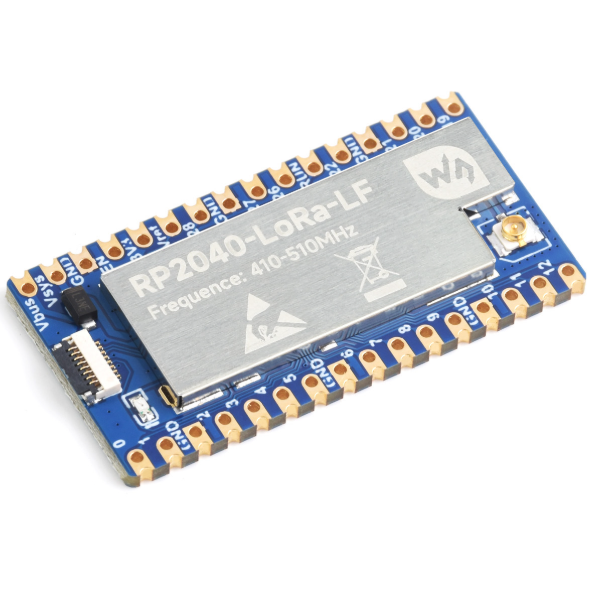
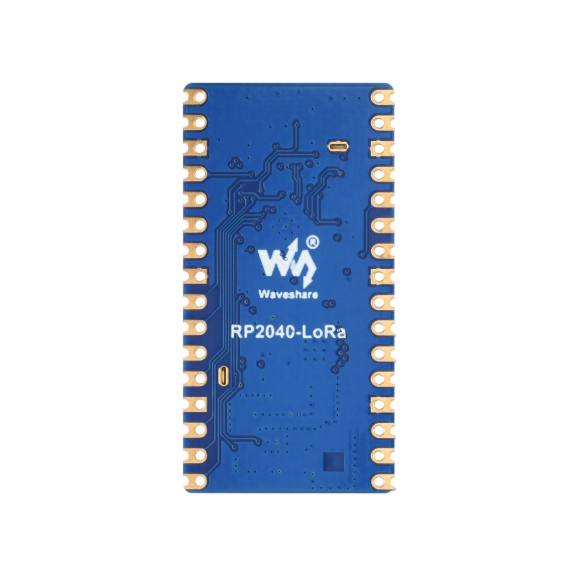
This is an integrated development board combining the Raspberry Pi RP2040 microcontroller and the Semtech SX1262 LoRa RF chip.
It is designed for:
- Low power consumption
- Long-range communication
- Easy development
- Scalable mass production integration
Supports:
- LoRa point-to-point communication
- Broadcast and relay networking
- LoRaWAN terminal development (with gateway support)
1. Core Positioning & Key Advantages
Microcontroller (MCU)
- Raspberry Pi RP2040 (official chip)
- Dual-core Cortex-M0+ @ 133 MHz
- 264 KB SRAM + 2 MB Flash
- Supports MicroPython, C/C++, and UF2 drag-and-drop programming
- Mature ecosystem, beginner-friendly
RF Performance (SX1262)
- Next-generation LoRa chip (upgrade from SX1278)
- Receiver sensitivity: -148 dBm
- Max transmit power: 22 dBm
- Ultra-low power: sleep < 2 μA
- Strong anti-interference performance
- Communication range: 5–8 km+ (line-of-sight)
Hardware Design
- Stamp-hole + pin header dual design
- Suitable for direct PCB integration (mass production)
- Also supports breadboard prototyping
- Detachable Type-C interface (via FPC connector)
- Enables debugging and programming
- Can be removed in production to reduce cost
Communication Protocols
- Native support for:
- LoRa point-to-point
- Broadcast
- Relay networking
- Supports LoRaWAN (Class A/B) via gateway integration
- Compatible with TTN and ChirpStack
- Ideal for LPWAN IoT deployments
2. Key Specifications (LF / HF Versions)
| Parameter | Specification |
|---|---|
| MCU | RP2040 (Dual-core Cortex-M0+ @133 MHz, 264 KB SRAM, 2 MB Flash) |
| RF Chip | Semtech SX1262 |
| Frequency | LF: 410–525 MHz (433/470 MHz) / HF: 850–930 MHz (868/915 MHz) |
| Modulation | LoRa / (G)FSK |
| Transmit Power | 0–22 dBm (10 / 13 / 17 / 22 dBm adjustable) |
| Receiver Sensitivity | -148 dBm @ 2.4 kbps (SF12, 125 kHz) |
| Data Rate | LoRa: 0.3–62.5 kbps; FSK: up to 300 kbps |
| Range | 5–8 km+ (LOS, 22 dBm + 5 dBi antenna) |
| Power Consumption | TX: 107–118 mA; RX: 5.3 mA; Sleep: <2 μA |
| Power Supply | 3.3V (Type-C or pin header), battery supported |
| Interfaces | SPI, GPIO, UART, I2C, PWM, ADC |
| Antenna | IPEX connector (supports SMA / external antenna) |
| Size | 21 × 41 mm (Pico-compatible form factor) |
| Operating Temp | -40°C to +85°C |
3. Onboard Hardware & Interfaces
RP2040 MCU Section
- Dual-core Cortex-M0+ up to 133 MHz
- Built-in 264 KB SRAM and 2 MB Flash
- Supports UF2 drag-and-drop programming (USB mass storage mode)
GPIO Expansion:
- 20+ multifunction GPIOs
- Supports SPI, I2C, UART, PWM, ADC
- Compatible with Raspberry Pi Pico ecosystem
Buttons & Indicators:
- Reset button
- BOOT button (enter programming mode)
- Power and status LEDs
Modular Design:
- Mainboard connects via FPC (8-pin) to Type-C adapter
- Adapter provides power, debugging, and programming
- Can be removed for direct PCB integration
SX1262 RF Section
- Independent RF circuit with shielding for improved stability
- IPEX antenna connector for external high-gain antennas
- SPI communication with RP2040
Supports advanced features:
- Wake-on-Radio (WOR)
- Listen Before Talk (LBT)
- CRC error checking
- RSSI detection
- Address filtering
- Data encryption
4. Core Functions & Development Features
LoRa Communication
- Point-to-Point / Broadcast / Multicast
Direct communication between nodes without a gateway - Multi-Hop Relay
Extends communication range and overcomes obstacles - LoRaWAN Terminal Support
Compatible with TTN and ChirpStack for cloud connectivity
Ultra-Low Power Operation
- Supports WOR (Wake-on-Radio)
- Nodes remain in sleep mode and wake periodically
- Battery-powered operation for months to 1 year
Development Ecosystem
- Programming Languages:
- MicroPython (recommended for rapid prototyping)
- C/C++ (Arduino / Pico SDK)
- Debugging:
- Type-C interface for serial communication
- PC tools for configuration and data transmission
- Resources:
- Official Wiki
- Schematics & PCB files
- Example code (Python / C)
- LoRaWAN integration examples
- AT command set
5. Typical Applications
IoT End Devices
- Temperature, humidity, pressure, liquid level, soil, PM2.5 sensors
- Smart meters (electricity, water, gas)
- Security systems (alarms, motion detection)
Industrial Wireless Systems
- PLC communication
- Equipment monitoring
- Remote control systems
- Factory IoT networking
Smart Agriculture & Environmental Monitoring
- Greenhouses
- Weather stations
- Water quality monitoring
- Forest fire detection
- Remote outdoor sensing
Battery-Powered Devices
- Long-range, low-power wireless transmission
- Ideal for remote and off-grid environments
Mass Production Integration
- Stamp-hole design enables direct soldering onto product PCBs
- Eliminates need for separate MCU + LoRa module
- Reduces system cost and complexity
6. Development & Usage Notes
Hardware Setup
- Connect via breadboard or solder onto baseboard
- Attach IPEX antenna (do not transmit without antenna)
- Power via Type-C or 3.3V
Quick Start
- Use MicroPython with SX1262 driver
- Configure frequency, data rate, and transmit power
- Use send/receive functions for communication
Frequency Compliance
- Use LF version (433/470 MHz) for China
- Follow local RF regulations for power and frequency
Important Notes
- SX1262 is a physical layer chip
- LoRaWAN requires protocol stack implementation or libraries
- Point-to-point communication does NOT require a gateway
- LoRaWAN requires a compatible gateway