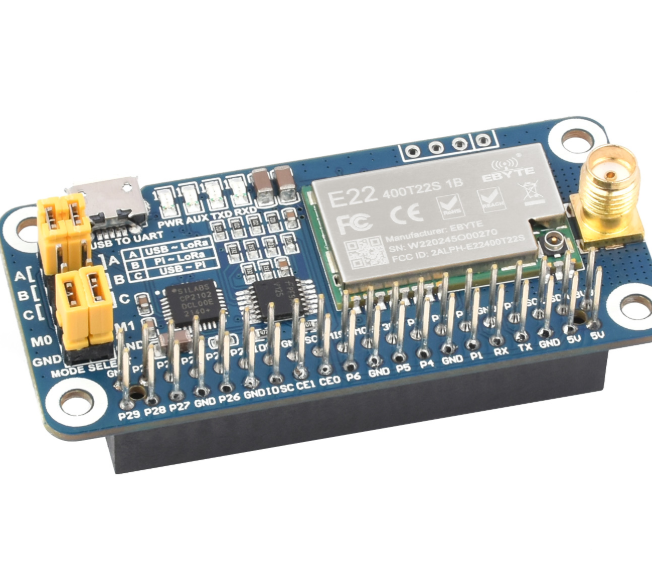
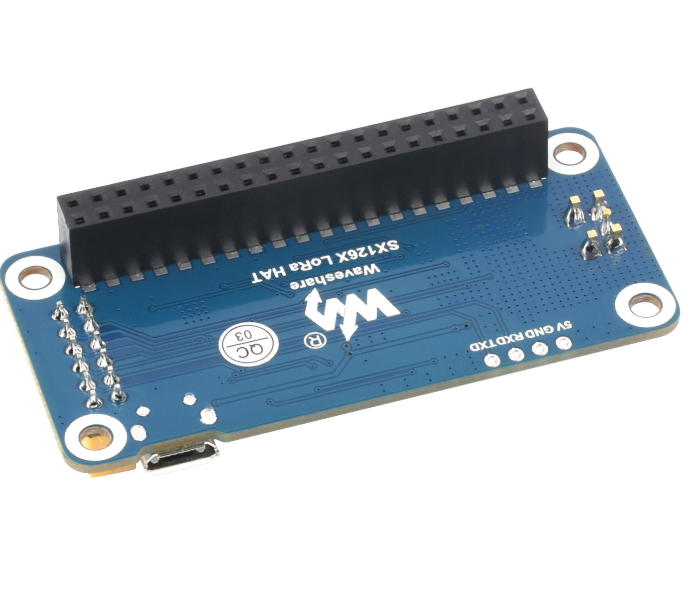
This product is a Raspberry Pi expansion board based on the SX1268/SX1262 chipset, integrating a LoRa-enabled wireless serial communication module.
It features:
- Multi-level relay for ultra-long-distance communication
- Low-power wake-up communication
- Encrypted data transmission
⚠️ Note: This product does NOT support LoRaWAN. It is designed for private LoRa networks (point-to-point, broadcast, and relay communication).
1. Core Positioning & Key Features
Designed for full compatibility with Raspberry Pi series (4B / 3B+ / Zero, etc.), this board connects directly via the 40-pin GPIO header—no soldering required, plug-and-play.
Key Highlights:
- Sub-GHz 433 MHz LoRa Communication
Adds long-range wireless capability to Raspberry Pi instantly - Next-Generation SX1268 Chip
Compared to SX1278:- Higher receiver sensitivity
- Lower power consumption
- Stronger anti-interference
- Longer communication range (up to 5 km+ line-of-sight)
- Dual Control Interfaces
- UART via Raspberry Pi GPIO
- Onboard CP2102 USB-to-UART for PC debugging
- Supports Raspberry Pi, PC, or external MCU (Arduino / STM32) control
- Industrial-Grade Features
- Wake-on-Radio (WOR)
- Listen Before Talk (LBT)
- Multi-level relay networking
- RSSI detection
- Data encryption
- Ultra-low power sleep
2. Key Specifications (SX1268 433 MHz Version)
| Parameter | Specification |
|---|---|
| RF Chip | Semtech SX1268 (433 MHz) |
| Frequency Band | 410.125–493.125 MHz (default 433 MHz, ISM license-free) |
| Modulation | LoRa Spread Spectrum / (G)FSK |
| Transmit Power | Up to 22 dBm (configurable: 10 / 13 / 17 / 22 dBm) |
| Receiver Sensitivity | -147 dBm @ 2.4 kbps (SF12, 125 kHz) |
| Air Data Rate | 0.3–62.5 kbps (programmable) |
| Communication Range | 5 km+ (line-of-sight, 5 dBi antenna); extendable via relay |
| Operating Voltage | 5V (via Raspberry Pi GPIO); logic level 3.3V |
| Power Consumption | TX: 110 mA; RX: 11 mA; Sleep: <2 μA |
| Channels | 81 selectable channels |
| Interface | UART (TTL), baud rate 1200–115200 bps (default 9600) |
| Antenna Interface | SMA (female) + IPEX; includes 2 dBi 433 MHz antenna |
| Operating Temperature | -40°C to +85°C (industrial grade) |
| Dimensions | Standard Raspberry Pi HAT size |

3. Onboard Hardware & Interfaces
Core Components
- SX1268 – Main LoRa RF chip (433 MHz)
- CP2102 – USB-to-UART converter for PC debugging and configuration
- 74HC125V – Level shifter for stable 3.3V / 5V compatibility
Interfaces
- 40-Pin GPIO Header
Direct connection to Raspberry Pi, uses UART interface - Micro USB Port
For CP2102 debugging (connect to PC for configuration and communication) - External UART Header
Supports Arduino, STM32, or other MCUs (standalone operation without Raspberry Pi)
Status Indicators (4 LEDs)
- PWR – Power indicator
- RXD / TXD – Serial communication indicators
- AUX – Status indicator (busy / wake-up / relay state)
Mode Selection Jumpers (M0 / M1)
Supports 4 operating modes:
| M0 | M1 | Mode | Description |
|---|---|---|---|
| 1 | 1 | Transparent Mode | Default, point-to-point / broadcast |
| 1 | 0 | Configuration Mode | Set frequency, rate, power, address, encryption |
| 0 | 1 | WOR Mode | Wake-on-radio (low power listening) |
| 0 | 0 | Sleep Mode | Deep sleep (<2 μA), external wake-up |
UART Selection Jumpers (A / B / C)
| Mode | Function |
|---|---|
| A | USB (CP2102) controls LoRa |
| B | Raspberry Pi GPIO controls LoRa (default) |
| C | USB accesses Raspberry Pi UART (for Pi debugging) |
4. Core Features Explained
LoRa Spread Spectrum Communication
Provides strong anti-interference and excellent diffraction performance, ensuring stable communication in complex industrial, outdoor, and building environments—far superior to traditional FSK/433 MHz modules.
Multi-Level Relay Networking
Supports automatic relay between nodes, overcoming obstacles and extending communication range for large-scale deployments.
Wake-on-Radio (WOR)
Enables ultra-low power operation:
- Nodes remain in sleep mode
- Periodically wake to listen
- Activate communication when triggered
👉 Ideal for battery-powered devices with months to 1-year lifespan.
Listen Before Talk (LBT)
Detects channel activity before transmission to avoid collisions and improve communication reliability in noisy environments.
Data Security & Reliability
- Encryption with communication keys
- Address filtering (unicast / broadcast)
- RSSI signal detection
- CRC error checking
Flexible Configuration
Parameters can be configured via:
- PC serial tools
- Raspberry Pi software
- External MCU
Adjustable settings include:
- Frequency
- Data rate
- Transmit power
- Channel
- Address
5. Typical Applications
- Raspberry Pi IoT Gateway / Node
Remote sensor data collection (temperature, humidity, PM2.5, liquid level, pressure) - Industrial Wireless Communication
PLC systems, instrumentation, remote monitoring, alarm systems - Smart Agriculture & Environmental Monitoring
Greenhouses, weather stations, soil and water monitoring - Smart Home & Remote Control
Wireless switching, door/window alarms, smart metering - Outdoor & Battery-Powered Projects
Long-range wireless transmission without wiring
6. Development & Usage Notes
Hardware Setup
- Plug directly into Raspberry Pi 40-pin GPIO
- Connect a 433 MHz antenna
- Set jumper to Mode B (Raspberry Pi control)
Software Support
- Complete documentation (Wiki)
- Python and C examples
- Serial configuration tools
- Raspberry Pi drivers
Important Notes
- ❌ Does NOT support LoRaWAN protocol
- ✔ Supports private LoRa networks (P2P / broadcast / relay)
- ⚠️ Configure frequency and transmit power according to local radio regulations before use