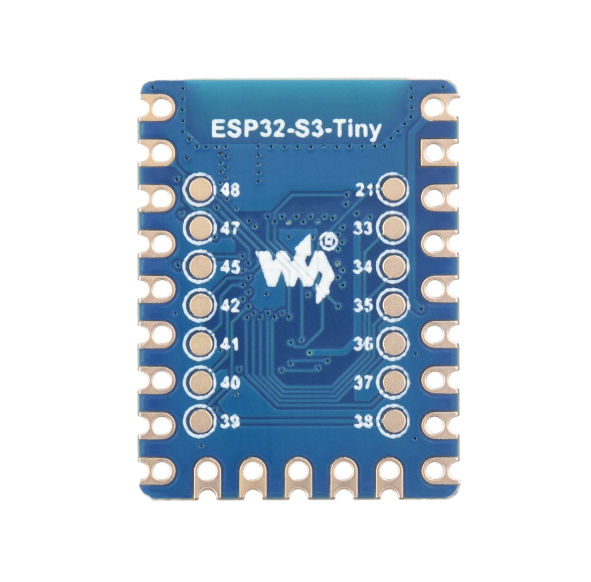
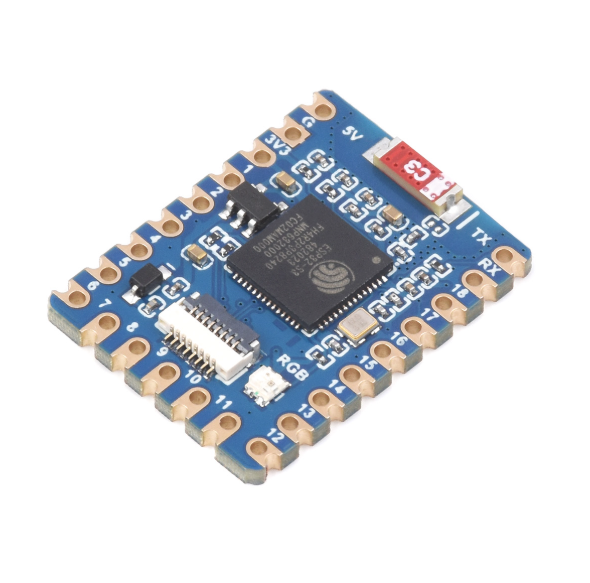
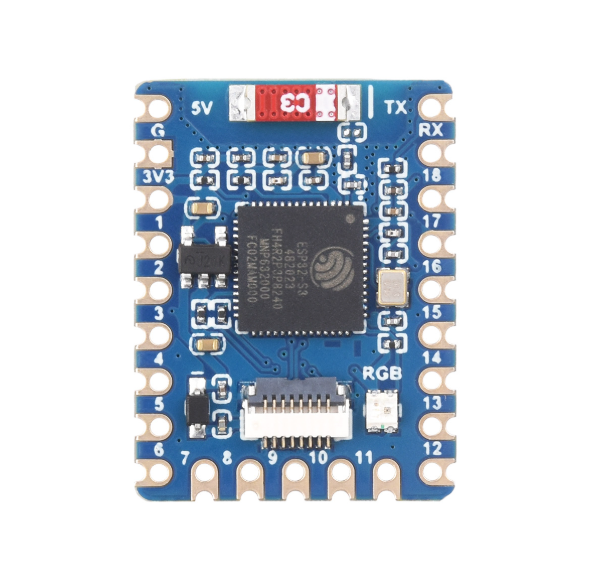
The ESP32-S3-Tiny is a small-sized microcontroller development board that comes with various digital interfaces. The product uses a split design, allowing the USB and button circuits to be separated, which reduces the overall PCB thickness and size. Despite its tiny form factor, it brings out 34 GPIO pins, making it easier for users to integrate it into their projects. Its split design, compact dimensions, and extremely thin thickness make it very suitable for projects that require a small footprint.
Hardware Overview:
The board is equipped with the ESP32-S3 chip, which integrates a high-performance Xtensa® 32-bit LX7 dual-core processor, ultra-low power co-processor, Wi-Fi baseband, Bluetooth baseband, RF module, and peripherals. It supports compatibility and expansion for various peripheral devices, making it more convenient for users.
Software Support:
It can be developed using the ESP-IDF development environment or the Arduino IDE, allowing for an easy and fast learning curve, and facilitating seamless application into products.
Core Hardware Specifications (Example: ESP32-S3-DevKitM-1 and General Mini Version)
- Core Processor:
- CPU: Xtensa® 32-bit LX7 dual-core processor, with a maximum clock speed of 240 MHz.
- AI Acceleration: Built-in vector instructions, supporting neural network computation and signal processing acceleration.
- Memory:
- Built-in: 512 KB SRAM + 384 KB ROM + 16 KB RTC SRAM.
- Onboard: 4–8 MB Flash, optional 2–8 MB PSRAM (external pseudo SRAM for larger displays/AI tasks).
- Wireless Communication:
- Wi-Fi: 2.4 GHz, 802.11 b/g/n, supports 20/40 MHz bandwidth.
- Bluetooth: Bluetooth 5 (LE), supporting long-range, Bluetooth Mesh.
- Size and Interfaces (Typical Mini Board):
- Board Type:
- Official: ESP32-S3-DevKitM-1 (dual-row pins, breadboard compatible).
- Third-party (e.g., MicroX ESP32-S3-Zero, Seeed XIAO ESP32-S3): Stamping holes / ultra-compact size (~20×17 mm).
- USB: USB Type-C, supports USB serial and direct USB download/debugging.
- GPIO:
- Official Version: About 39 GPIO pins.
- Mini Version: Typically 20–28 usable GPIO pins.
- Peripherals:
- 4×SPI / 2×I2C / 3×UART / 2×I2S.
- 12-bit ADC (multiple channels), touch sensor, temperature sensor.
- Supports LCD interface, DVP camera interface.
- Buttons: BOOT (download), RESET (reset).
- Antenna: Onboard PCB/ceramic antenna, some versions support external IPEX antennas.
- Board Type:
- Electrical Characteristics:
- Power Supply: 3.0–3.6 V (USB 5V direct input).
- Power Consumption:
- Active (Wi-Fi): ≈80–110 mA.
- Deep Sleep: <30 μA.
- Operating Temperature: -40°C ~ 85°C.
Product Features
- ESP32-S3 Chip: Integrates a high-performance Xtensa® 32-bit LX7 dual-core processor with a clock speed of up to 240 MHz.
- Memory Integration: 512 KB SRAM, 384 KB ROM, 16 KB RTC SRAM, 2MB PSRAM, and 4MB Flash storage.
- Wireless Connectivity: Integrated low-power Bluetooth (Bluetooth LE) and 2.4 GHz Wi-Fi with excellent RF performance.
- USB Type-C Interface: No need to worry about the orientation of the connector.
- Rich Peripheral Interfaces: Allows flexible implementation of various functionalities.
- Low-Power Modes: Multiple low-power states, with adjustable communication rates and power consumption to meet the demands of different application scenarios.
Core Advantages
- Ultra-Compact Size: Retains full dual-core processing, wireless, and peripheral functionality while achieving coin-sized dimensions, suitable for wearables, portable, and embedded products.
- AI Computing Power: LX7 dual-core with vector instructions, enabling local execution of neural networks (speech recognition, gestures, image classification).
- Developer-Friendly:
- Supports Arduino, MicroPython, and ESP-IDF (official SDK).
- USB direct download / serial debugging, no additional downloader required.
- Low Power: Multiple sleep modes and long battery life for extended standby.
- High Security: Supports encrypted boot, secure boot, Flash encryption, and digital signatures.
Typical Applications
- Wearable Devices: Smart bands, health monitoring.
- Smart Home: Miniature sensors, smart switches, remotes.
- IoT Nodes: Industrial data collection, environmental monitoring.
- AI Local Interaction: Offline voice wake-up, gesture recognition.
- Consumer Electronics: Drones, camera accessories, toys.
- Small Display/Touch Devices: Smart gauges, door panels.
We specialize in ESP32-S3 platform development and can undertake various custom development needs, including Wi-Fi, Bluetooth, low-power control, offline AI computation, sensor acquisition, screen driving, and more. We support demand customization, secondary development, and joint project R&D. Based on real-world application scenarios, we can create highly adaptable, high-stability ESP32-S3 integrated solutions for clients.